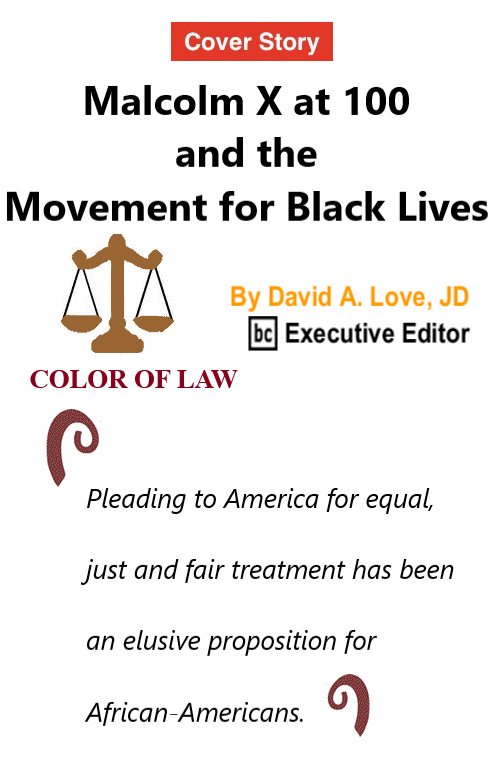
May 19 marked the 100th birthday of Malcolm
X, the man who
articulated a message of racial justice that
made him far ahead of his time. He believed
the black struggle for civil rights must be
expanded to the level of human rights, a
message which the Black Lives Matter and
related movements should incorporate into the
current public discussion on race in order to
move it forward.
As the nation grapples
with the seemingly intractable nature of
institutional racism and inequities in the
justice system, the slain leader resonates
with a twenty-first century Black Lives Matter
movement born decades after his death. Yet,
the present-day movement fights the same
hopelessly persistent problem of American
racism and fascism, one born of the badge of
slavery.
Malcolm had much to say
regarding the precarious, if not ephemeral or
even illusory nature of civil
rights for African-Americans, who were originally
noncitizens, regarded as property and not
human, and therefore excluded from the
protections of the Constitution. “They don’t
need additional legislation to make anyone who
comes to this country a citizen, but when it
comes to the rights of the black people who
are the descendants of slaves, then new
legislation is necessary,” he said.
Making a clear
distinction between civil rights and
human rights, Malcolm X framed the
former as a domestic affairs issue. “Whenever
you are in a civil-rights struggle, whether
you know it or not, you are confining yourself
to the jurisdiction of Uncle Sam. No one from
the outside world can speak out in your behalf
as long as your struggle is a civil-rights
struggle,” he argued. “Civil rights means
you’re asking Uncle Sam to treat you right.
Human rights are something you were born
with.”
And pleading to America
for equal, just and fair treatment has been an
elusive proposition for African-Americans.
“There is something about civil rights that
makes it almost impossible for us to get,”
Malcolm X argued. After all, in a nation that
often stands in blissful denial over the very
existence of racial inequities, the benefits
conferred by white skin privilege have been so
ingrained as to become normalized. Any
suggestion that the playing field should be
leveled, that inclusivity should reign and the
wrongs should be eradicated, is met with white
backlash, false claims of “reverse racism” and
a form of self-righteous grievance also known
as “white tears.”
Further, the way in
which the victims of racism are treated in the
U.S. reflects a refusal to come to terms with
it. While institutional racism is hardwired
into the fiber of America, the victims of
racial injustice are left to prove that
someone intended to discriminate against them.
A stumbling block to justice, the civil rights
mindset assumes that the ability to read the
mind or heart of an accused perpetrator of
racism is of greater consequence than the
existence of systemic, multigenerational
barriers to equality - of systems of
oppression that steal lives, livelihoods and
spirits in broad daylight and on a daily
basis.
Meanwhile, the human
rights approach to racism focuses on the end
result, the damage that has been done. “When
we begin to get in this area, we need new
friends, we need new allies,” Malcolm noted,
as the civil rights struggle is elevated to
one of human rights. When African-Americans
begin to view their plight with a human rights
lens, they are able to link their predicament
with that of people of African descent in
Latin America, Europe and throughout the
diaspora. And in the process, they establish
connections with groups such as the Roma in
Europe, the Dalits in India, and the
Palestinians in Gaza and the West Bank.
“They
keep you wrapped up in civil rights. And you
spend so much time barking up the
civil-rights tree, you don’t even know
there’s a human-rights tree on the same
floor,” Malcolm said. The leader’s words
provide guidance on how to address today’s
reality of racism.